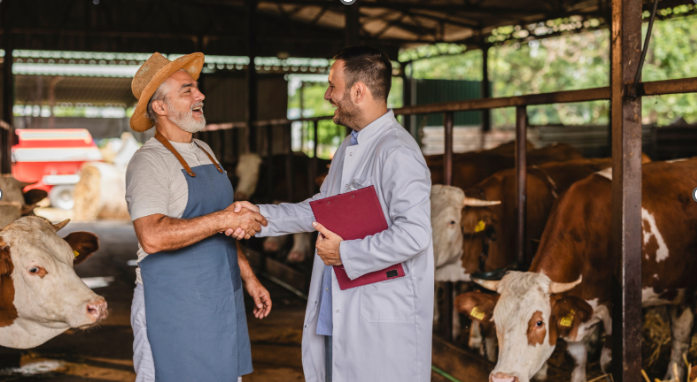
The Welfair® certificate certifies animal welfare on farms, in slaughterhouses, and in industries. Discover what it guarantees, how it is obtained, and what benefits it brings to companies.
TheWelfair® Animal Welfare certificatehasbecome one of the most valued sealsofapproval for producers, distributors, and food industries seeking to guarantee responsible, transparent processes that are aligned with current market demands. This European model, based on scientific methodologies, assesses the actual welfare of animals throughout their entire production cycle.
As a certification body specializing in the agri-food sector,ACERTAoffers companies comprehensive support to obtain this certification with guarantees, complying with all the technical and regulatory requirements of the Welfair® standard.
What is the Welfair® certificate and what does it guarantee?
Welfair® animal welfare certificationis an independent seal approved byIRTAandNeiker Tecnalia, based on European standards. Welfare Quality® andAWIN® standards, whichallows forthe objective evaluation of animal conditions at each stage of the production process. Its objective is to comprehensively evaluate animal welfare on breeding and fattening farms and in slaughterhouses, ensuring that each animal has been treated according to criteria of quality, respect, and health.
This pioneering model in Europe is based onfour fundamental principles, developed from widely validated scientific criteria:
| Good accommodation | Good nutrition | Good health | Appropriate behavior |
|---|---|---|---|
|
|
|
|
Which companies should become Welfair® certified?
Certification is highly recommended (and even required by some distributors) in:
Production farms
- Cattle (meat and milk)
- Swine
- Sheep (meat and milk)
- Goat
- Rabbits
- Poultry (chickens, laying hens, turkeys, quails)
Slaughterhouses: Toensure proper handling, stunning, and pain-free processes. In addition to traceability between farms and food industries.
Food industries: Toguarantee the traceability of the final product (labeled with the Welfair® label) and the origin of the raw material from farms certified in animal welfare throughout the entire production cycle.
How does the Welfair® certification system work?
TheWelfair® animal welfare certification processis regulated by technical guidelines that define each stage of the assessment.
The guide establishes a very detailed structure, which regulates the process from operator registration to the final decision. The steps are as follows:
The Welfair® animal welfare certification process is regulated by technical guidelines that define each stage of the assessment. The guidelines establish a very detailed structure that regulates the process from operator registration to the final decision. The steps are as follows:
1. Registration and application
- The applicant must complete the Certification Application, which defines:
 Modules to be certified (farms, slaughterhouses, industries)
- Included species
- Number of farms (individual or multi-site certification)
- REGA/RGSEAA data
- Number of animals, structures, and processes
- With this information, ACERTA determines the scope of the audit based on:
- Animal census
- Number of warehouses
- Type of production
- Official sampling frequencies
2. Document evaluation and work order
- After reviewing the application:
- A file code WELF.XXXXX-AA is assigned.
- The scope of the module and planning are defined.
- An auditor authorized by Welfair® and qualified by Welfare Quality and AWIN is assigned.
- The Audit Plan is prepared and sent.
Why Welfair® certification adds value to companies in the food sector

Growing consumer demand for animal welfare has driven the expansion of the Welfair® label. Today, having this certification represents clear added value for any food operator.
Understandinghow to obtain the Welfair® sealis key for companies seeking to differentiate themselves and demonstrate a genuine commitment to animal welfare.
Key benefits
- Access to high value-added markets
- Boostingconsumer confidence
- Greater transparency and traceability
- Alignment withsustainability, ESG, and CSR policies
- Competitive differentiation from other companies in the sector
- Promotion ofcontinuous improvementon farms and in slaughterhouses (improvements in production yields, reduction in the incidence of disease, reduction in animal stress)
By certifying with ACERTA, companies have a recognized entity with extensive experience in food safety,animal welfare, and management system audits.
Is your company looking to certify animal welfare with guarantees?
Welfair audit: what exactly is evaluated
In aWelfair® audit, the auditor assesses compliance with the protocols applicable to each species and the actual conditions of animal management and welfare.
Rev. 3.0 specifies that audits include:
A. Evaluation according to WQ or AWIN® protocol
Depending on the species:
- Welfare Quality® applies to dairy and beef cattle, market hogs, and chickens.
- Based on WQ applies to pig, cattle, and poultry slaughterhouses.
- AWIN® is suitable for sheep, lambs, and turkeys.
- WQ Inspired for rabbits, breeding rabbits, young rabbits, quails, etc.
B. Review of legal requirements
Compliance with all applicable animal welfare legislation must be verified:
- Management
- Spaces
- Stunning
- Transportation
- Hygiene
- Specific requirements by species.
Any legal non-compliance blocks certification, regardless of the technical score.
C. On-site supervision
The auditor must observe:
- Animals (physical condition, injuries, lameness, behavior, mortality, etc.).
- Environmental conditions.
- Facilities.
- Food and water systems.
- Internal records and protocols.
D. Mandatory documentation
The following must be used in each audit:
- Audit report
- Legal checklists
- Field notes
- Score spreadsheets
- Final report
- Corrective Action Plan (if applicable)
Calculation of Welfair® scores and levels
The certificate is granted when the farm reaches the required level according to its cycle:
- Pre-initial cycle→ minimumSufficient(20–54 points) in modules still under development.
- Initial cycle→Goodminimum (55–79 points).
- Experienced and consolidated cycle→ minimumGoodorPlus(≥ 80 points, depending on species).
In addition to specific scoring requirements for certain production systems.
Essential requirements for obtaining Welfair® certification
To obtain certification, farms and slaughterhouses must meet a series of minimum conditions:
✓ Compliance with the 12 criteria of the model. Each criterion is evaluated using different measures that must achieve the required score, depending on the species being evaluated.✓ Absence of legal violations. The certificate cannot be granted if there are regulatory violations related to animal welfare.
✓ Effective traceability systems. These are especially important in slaughterhouses and food industries.
✓ Clear documentary evidence. Records of health, feeding, handling, losses, injuries, environmental controls, etc.
✓ Adequate staff training. Especially for group certifications or farms linked to integrators.
Would you like to become certified in Animal Welfare with ACERTA?
If your company needs to start theWelfair® certification process, our team can guide you. At ACERTA, we accompany your company throughout the entire process, from initial planning to the final audit.
Obtaining theWelfair® sealallows companies to verifiably demonstrate their commitment to animal welfare and offer additional guarantees to customers, distributors, and consumers.
👉 Request your quote here and take the step towards more ethical, sustainable, and competitive production.
Frequently Asked Questions Frequently Asked Questions
-
The Welfair certificate is an independent animal welfare certification that scientifically assesses the actual conditions of animals on farms and in slaughterhouses. The Welfair seal guarantees compliance with European criteria for good housing, feeding, health, and behavior, ensuring responsible and verifiable management.
-
To obtain Welfair certification, it is necessary to submit an application, define the scope (species and module), pass an audit carried out by an authorized auditor, and comply with all the legal and technical requirements of the model. Only after verifying full compliance is certification granted.
-
To obtain Welfair certification, it is mandatory to comply with the 12 criteria of the animal welfare model, have no legal violations, have effective traceability systems in place, and maintain documentary records that prove continuous compliance throughout the entire production cycle.