At ACERTA we verify the carbon footprints of companies and organizations, providing technical rigor and independence to verify the accurate quantification of greenhouse gas emissions and enhance the reliability of the climate-related information reported by the organization.
The carbon footprint allows for the quantification of greenhouse gas (GHG) emissions generated directly and indirectly by an organization’s activities and is typically expressed in metric tons of CO₂ equivalent (tCO₂e).
Verification allows for independent confirmation that the data, calculations, emission sources, emission factors, and methodology used to determine the footprint are consistent with the applicable criteria and are supported by evidence.
At ACERTA, we conduct independent verification of the carbon footprint for companies and organizations, ensuring the reliability and traceability of information regarding their GHG emissions.
Important Note: Service intended for companies and organizations that need to verify their carbon footprint. ACERTA acts as an independent verification body and does not calculate the carbon footprint that is the subject of its own verification.
The carbon footprint of an organization represents the greenhouse gas emissions directly and indirectly associated with its activities and allows it to measure and manage its climate impact.
Emissions are typically classified into three scopes:
Among the standards and guidelines used for quantifying and verifying emissions are the GHG Protocol, ISO 14064, and ISO 14067, the latter of which is specific to the product carbon footprint.
The carbon footprint verification involves independently evaluating the data, calculations, emission sources, and evidence supporting the reported information.
Verifying the footprint ensures reliability and traceability to emissions data and helps identify potential errors or inconsistencies in their quantification.
The need to verify a carbon footprint depends on the characteristics of the organization, the emissions included in the calculation, and the applicable requirements.
The Royal Decree 214/2025, dated March 18, also stipulates that certain companies required to report on non-financial matters must calculate their carbon footprint annually, develop a reduction plan, and publish this information.
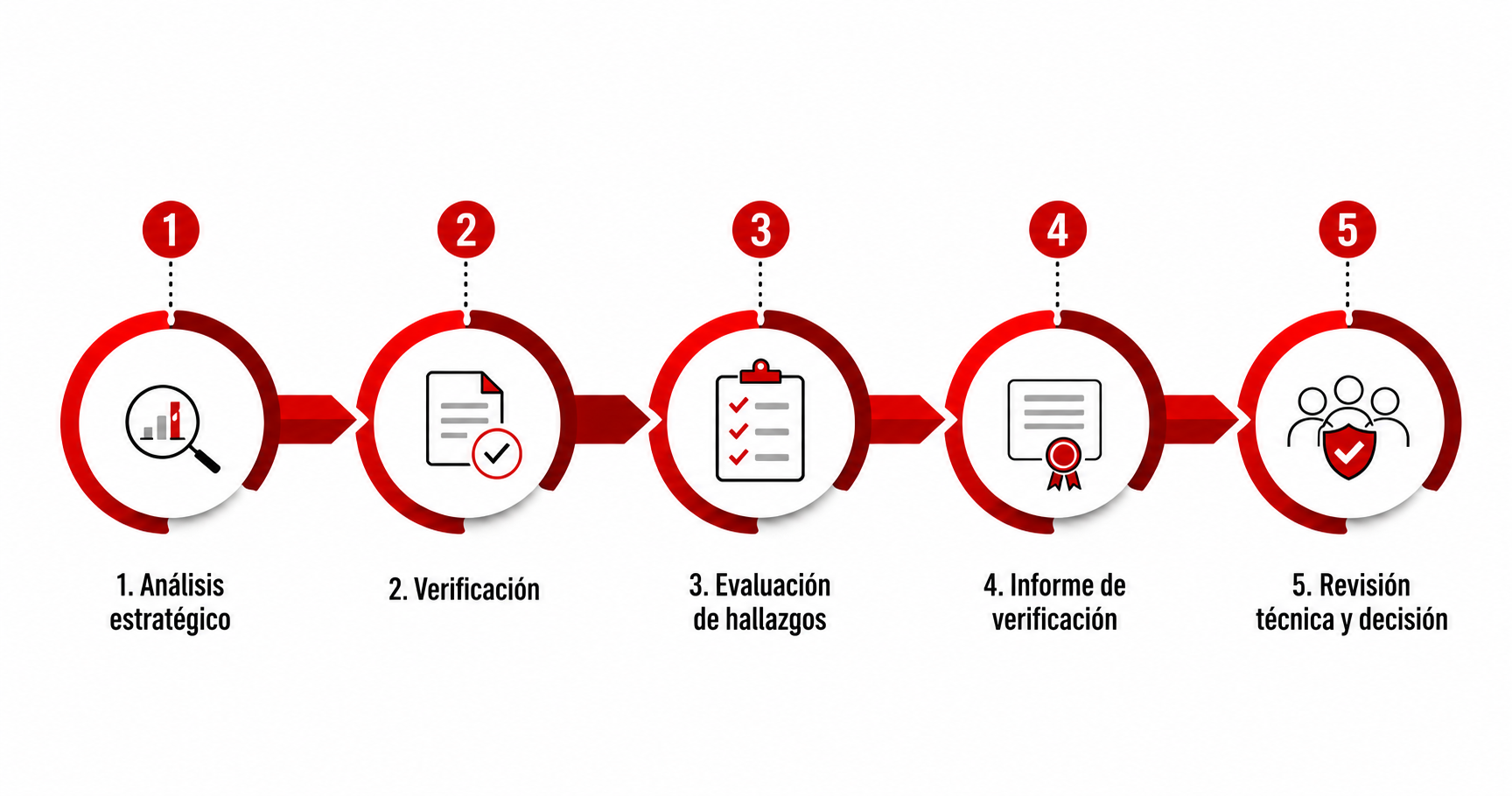
The process of carbon footprint verification allows for independent verification of the reliability of the data, calculations, and evidence used by an organization to quantify its greenhouse gas emissions.
Although the scope will depend on the characteristics of each organization, the verification process consists of the following phases:
The documentation will depend on the scope, methodology, and characteristics of the organization. In general, the following may be reviewed:
Having information that is that is complete, traceable, and supported by evidence facilitates verification and allows for the reliability of reported results to be confirmed.
The carbon footprint verification provides an independent assessment of information on greenhouse gas emissions and reinforces the reliability and traceability of the data reported by the organization.
Among its main benefits are:
The results of the verification give the organization greater credibility and ensure the reliability of the data provided to stakeholders, including the government.
Verification is performed by ACERTA to verify the correct quantification of emissions, the appropriateness of the sources and factors used, and compliance with standards such as UNE-EN ISO 14064, the GHG Protocol or UNE-EN-ISO 14067, verifying the accuracy of the data from its source. Our work includes:
The resulting documentation allows the organization to demonstrate the independent verification of its carbon footprint and submit it to the government when necessary.
Choose a verification provider with technical competence and independence helps ensure the reliability and traceability of the emissions data reported by the organization.
With ACERTA, you get:
Tell us what carbon footprint you’ve calculated, what scopes it includes, and why you need to verify it. Our team will let you know the scope and the information needed to begin the process.
It depends on the organization, the emissions included, and the intended use of the footprint. For certain cases of registration with the MITECO Registry, external verification is required.
For companies required to calculate and publish their carbon footprint in accordance with Royal Decree 214/2025, registration in the State Registry is voluntary.
The verification may cover Scopes 1, 2, and 3, depending on the calculated footprint and the applicable requirements.
The calculation quantifies GHG emissions. The verification independently evaluates the data, calculations, methodology, and evidence supporting that result.
It depends on the scope, size, and complexity of the organization, as well as the available information and any clarifications that may be needed.
Our team can analyze your case and guide you through the requirements, necessary documentation, and steps to begin the process with ACERTA. Contact us for a free consultation, and we'll respond within 24 hours.
If you have any questions, comments or suggestions, please do not hesitate to contact us.