
GLOBALG.A.P. is an international certification for good agricultural practices that ensures food safety, traceability, and sustainability in primary production. It is currently one of the most widely required standards by supermarkets, distributors, and international operators in the agrifood sector.
With hundreds of thousands of certified producers in more than 135 countries, GLOBALG.A.P. has established itself as an international benchmark for agricultural and aquaculture operations seeking access to domestic and international markets.
If you work in agriculture, livestock farming, or food exports, understanding what GLOBALG.A.P. is, what its requirements are, and how the certification process works is key to operating with confidence in increasingly demanding markets.
What is GLOBALG.A.P.?
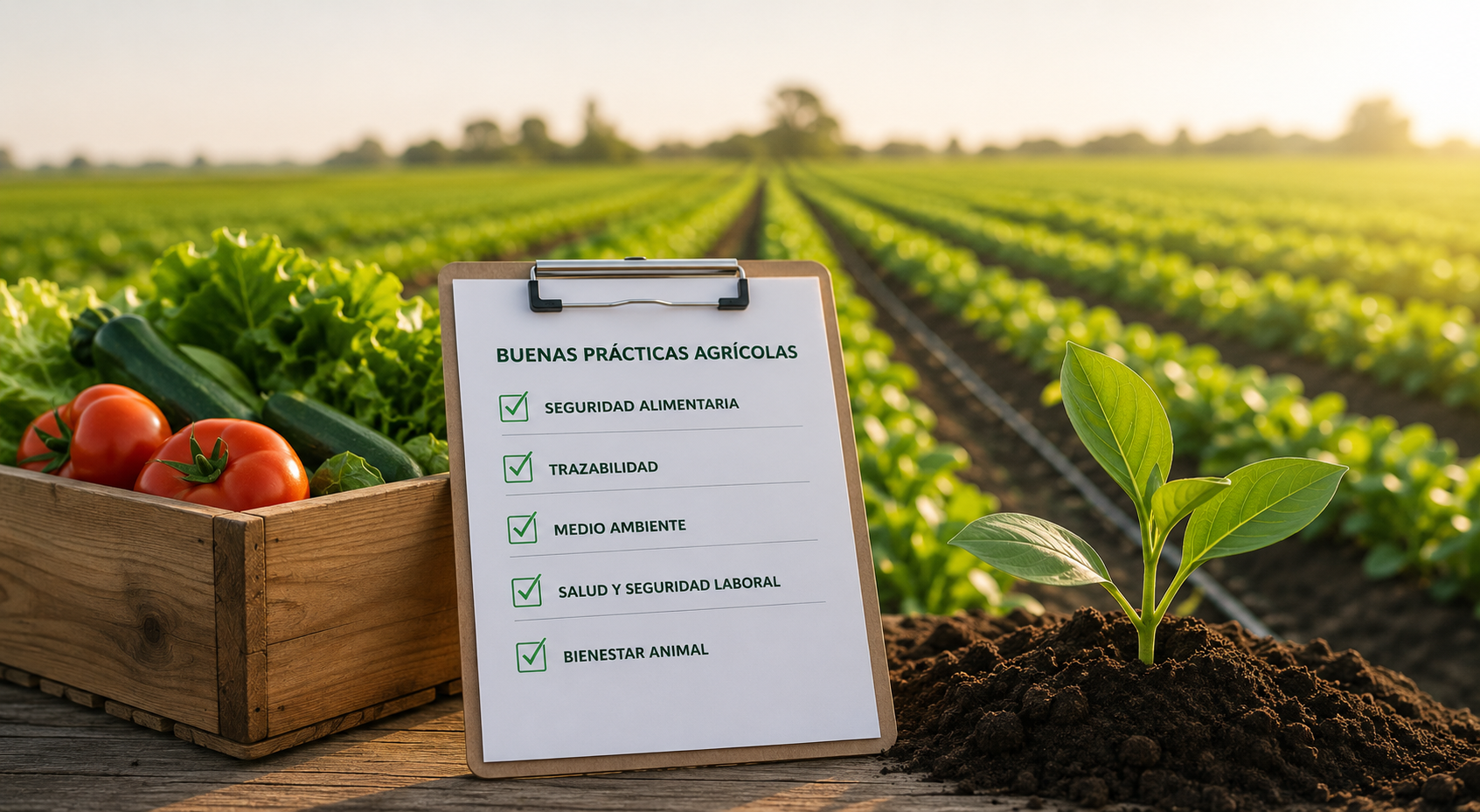
GLOBALG.A.P. is an international standard that certifies that a farm or floriculture operation follows good practices in areas such as:
- Food security
- Traceability
- Environmental sustainability
- Occupational Health and Safety
- Animal welfare
It is one of the most widely used private standards globally for primary production.
Its origins date back to 1997, when several European retailers launched the EUREPGAP initiative in response to growing concerns among consumers and distributors about food safety and traceability. In 2007, the program was renamed GLOBALG.A.P. and expanded its international reach.
In practical terms, GLOBALG.A.P. certification verifies that agricultural production is carried out in accordance with standardized technical criteria that can be audited by independent bodies.
How does the GLOBALG.A.P. standard work?
The GLOBALG.A.P. standard establishes a set of technical requirements designed to ensure safe, responsible, and traceable production.
The main standard is IFA (Integrated Farm Assurance), which applies to sectors such as:
- Fruits and vegetables
- Aquaculture
- Flowers and Ornamentals
- Hops
- Bulk crops
- Plant propagation material
The standard defines criteria that can be verified through external audits, assessing aspects related to food safety, process control, responsible use of resources, and document management.
Current version of GLOBALG.A.P.
Effective January 1, 2024, audits must be conducted in accordance with Version 6 of the IFA standard, replacing Version v5.2 (effective January 1, 2024) and Version v5.4-1-GFS (effective January 1, 2025).
Version 6 includes significant changes in:
- Sustainability
- Risk Management
- Traceability
- Document digitization
- International harmonization of requirements
Who needs GLOBALG.A.P. certification?
GLOBALG.A.P. certification is primarily intended for primary production operators:
- Farmers
- Cooperatives
- Agri-food exporters
It can also be applied to companies in the supply chain through specific schemes such as CoC (Chain of Custody).
In practice, GLOBALG.A.P. has become a standard requirement for working with large supermarket chains, importers, and international distributors, particularly in European markets. Although it is not a legal requirement, it is a common commercial requirement for accessing certain distribution channels. Therefore, any new certification or renewal process must comply with the current version.
Benefits of GLOBALG.A.P. Certification
GLOBALG.A.P. certification offers clear competitive advantages:
- Access to international markets: Many international supermarkets and distributors require GLOBALG.A.P. certification as a condition for approving agricultural suppliers.
- Building trust: Certification instills confidence in customers, importers, and end consumers by demonstrating a commitment to food safety and traceability.
- Improves traceability: The standard requires documented systems that allow the product to be traced from its origin to the point of sale.
- Risk mitigation: Implementing preventive controls helps minimize incidents related to contamination, operational errors, or regulatory noncompliance.
- Promoting sustainability: GLOBALG.A.P. incorporates criteria related to efficient water management, soil conservation, reduction of environmental impacts, animal welfare, and working conditions.
What exactly does GLOBALG.A.P. certify?
One of the issues that raises the most questions is what GLOBALG.A.P. actually certifies.
The standard does not certify the final product as "better" or "safer" in and of itself. What it does certify is that the farm implements a production system that complies with the technical requirements of good agricultural practices.
The audit evaluates:
- Production processes
- Traceability
- Documentation
- Use of supplies
- Hygiene
- Environmental Management
- Working Conditions
- Operational controls
Therefore, the focus is on the management and production system, not just on the product itself.
GLOBALG.A.P. Standard Requirements
The GLOBALG.A.P. requirements cover the entire production cycle and are organized into different areas.
Food safety: This includes risk management, contamination prevention, hygiene, the proper use of pesticides and veterinary drugs, and the safe storage of products. Food safety is one of the central pillars of the standard.
Traceability: The farm must be able to identify the product’s origin, batches, treatments applied, internal movements, and commercial destination. Traceability must work both forward and backward in the supply chain.
Environmental management: Aspects related to water efficiency, soil conservation, waste management, biodiversity protection, and environmental impact reduction are evaluated.
Working conditions: The standard requires staff training, occupational safety measures, the use of PPE, compliance with labor regulations, and an explicit prohibition on child and forced labor.
Animal welfare: In livestock and aquaculture operations, factors such as feeding, housing, health, management, and the prevention of animal suffering are evaluated.
All of these requirements are verified through audits conducted by accredited certification bodies.
Types of GLOBALG.A.P. Certification
GLOBALG.A.P. offers different schemes depending on the type of activity.
IFA (Integrated Farm Assurance)
It is the primary standard for primary production. It currently operates under version 6, with two modes:
The GFS scheme is GFSI-recognized.
CoC (Chain of Custody)
CoC certification ensures the traceability of certified products throughout the supply chain. It applies in particular to logistics operators, warehouses, retailers, and distributors.
Add-ons
These are optional supplementary modules that expand the scope of the certification. Among the most common are:
- GRASP (Social and Occupational Assessment)
- Animal Welfare Modules
- SPRING (Sustainable Irrigation and Groundwater Use Program)
Group certification
It allows small-scale producers to obtain certification collectively through cooperatives or associations with three or more members, thereby reducing costs and simplifying administrative procedures.
What a GLOBALG.A.P. audit is like
The GLOBALG.A.P. audit is the process by which an accredited certification body verifies compliance with all the requirements of the standard.
The assessment combines:
- Literature review
- Physical inspection of facilities
- Staff interviews
- Verification of records
- Traceability exercises
During the IFA audit, the inspector reviews aspects such as the use of pesticides, storage, hygiene, water management, animal welfare, workplace safety, and production records.
Any nonconformities identified must be corrected within the specified timeframes in order to obtain or maintain certification.
Audits may be announced or unannounced. In addition, certification requires annual audits for maintenance.
How to Obtain GLOBALG.A.P. Certification, Step by Step
The GLOBALG.A.P. certification process follows a clear structure:
- Initial assessment of the farm's condition
- Compliance with GLOBALG.A.P. standards
- Implementation of records and controls
- Internal Audit
- External audit by a certification body
- Issuance of the certificate
- Annual follow-up
How much does GLOBALG.A.P. certification cost?
The cost of GLOBALG.A.P. certification depends on:
- Farm size
- Type of activity
- Scope of the certification
There is no set price: each project is evaluated on a case-by-case basis.
Common mistakes when obtaining GLOBALG.A.P. certification
- Lack of documentary records
- Poor traceability management
- Lack of staff training
- Failure to conduct the internal audit
- Misinterpretation of the rule
Questions Frequently Asked Questions
-
It is not legally required, but it is a market requirement. A producer will need GLOBALG.A.P. IFA certification to do business with certain supermarket chains.
-
GLOBALG.A.P.
It focuses on primary production. It certifies that products are produced in accordance with good agricultural practices, ensuring food safety, sustainability, and traceability from the source.ISO 22000
An international food safety management standard applicable to the entire supply chain (production, processing, distribution). It focuses on management systems and risk control.BRC
A standard designed for the food industry and food processors, particularly supermarket suppliers. It sets very high standards for food safety, quality, and legal compliance.IFS
Similar to BRC, it applies primarily to manufacturers and processors. It assesses food safety and quality. -
The certificate is valid for one year minus one day.
-
Yes, group certification is available for cooperatives or associations with three or more members, which helps reduce costs and simplify administration.
-
In the case of the IFA standard, it certifies the production process, not the product itself.
-
The GGN (GLOBALG.A.P. Number) is the unique number that each producer receives upon certification, which allows them to identify and verify their certification internationally.